

Hello everyone, this week’s booklist features a selection of historical reads where our young protagonists have overcome some form of health-battle or illness. Be warned friends, some of these reads have themes and settings that could lead to episodes of crying…
Just like last week, I am focusing on four titles that deliver a narrative featuring the strength and courage of a group of heroic tweens through several historical eras and regions of the world.
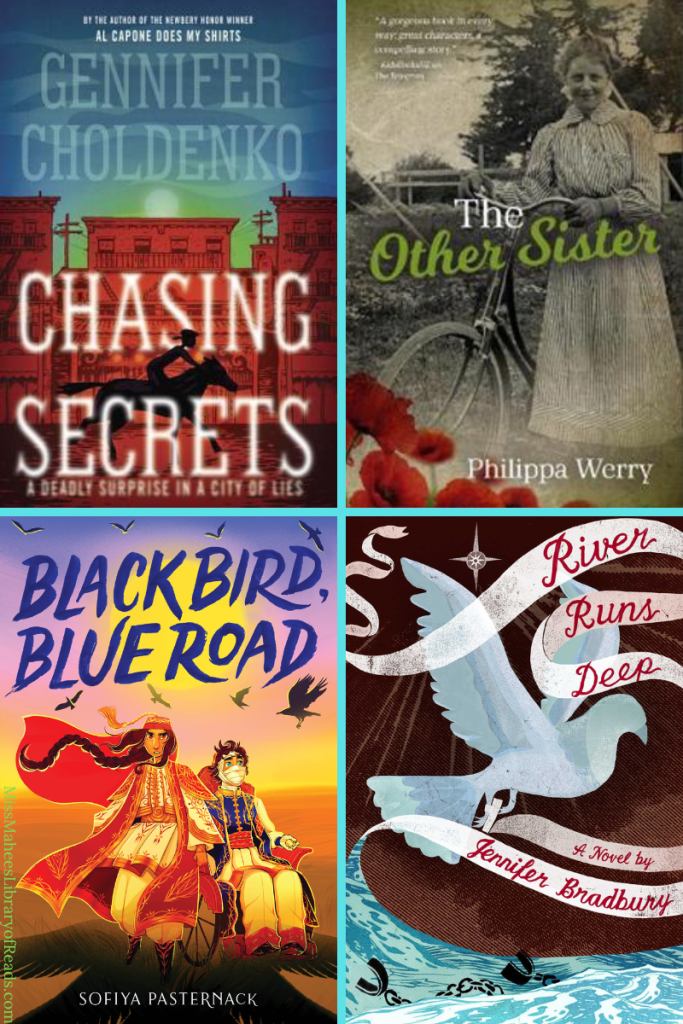
My first title, River runs deep by Jennifer Bradbury (Antheum Books for Young Readers; 2015), is set in Virginia during the 1840’s. Twelve-year-old Elias is sick with consumption and he’s been sent to live in the heart of the biggest cave in America. It’s said that the cool damp air of Mammoth Cave can heal consumption. At first it sounds like an adventure, but the truth of it is, all that lying around can get mighty boring mighty quickly. So on days he’s feeling less peaked, Elias starts tagging along with Stephen, Doc Croghan’s slave. What Elias discovers is that there is a whole lot more than a bunch of sick folk deep in those winding tunnels. In fact, there’s a secret so huge that Elias will have to decide whether or not he’s willing to risk his life to protect it. This was one of those books that illuminated readers with more than one lesson. Set during the 1840’s in a divided America when slaves struggled to find the definition of freedom, I found myself learning more than I could have imagined. Bradbury has done an exceptional job of describing not only Elias’s physical surroundings inside the cave but also of the different personalities of those that he encountered. An exceptional piece of work based on actual events!!.
We venture closer to the twentieth century in Chasing secrets by Gennifer Choldenko (Wendy Lamb Books; 2015) when we travel to San Francisco in 1900; also known as the Gilded Age. Our young heroine, thirteen-year-old Lizzie Kennedy has a secret passion in science, an unsuitable subject for finishing school students. On a visit with her physician father she discovers a hidden dark side of the city – a side that’s full of secrets, rats, and rumours of the plague. Newbery Honor winning author Gennifer Choldenko mixes her signature style of humour, tragedy, and fascinating historical detail in this medical mystery. If you enjoy stories with attention to those period details, then this is definitely the read for you. I found myself learning not just about the plague that reached San Francisco, but also of the cultural and social upheavals that occurred at the turn of the century.
My next selection tells of a similar event, one could even say it mirrors our current status of the world. The Other Sister by Philippa Werry (Pipi Press; 2021) takes us to New Zealand during those years just as World War One ends. January 1920 heralds the start of a new decade, promising fresh opportunities for girls like Tilly. But her dreams seemed impossible to reach, outweighed by all the things that girls can’t or aren’t supposed to do. The war is over, but its shadow still darkens the town. Returned servicemen struggle to fit back into their lives. Some have shell shock while others are crippled or bladed. Tilly must work out what it means to grow up in a world shattered by war and a pandemic, in a society where opportunities for women are still hard won. And, like any fourteen-year-old, she faces uncertainty and confusion about what sort of person she wants to be, how to get there, and how to believe in yourself. This sequel to The Telegram, takes the reader on a journey with Beatty’s younger sister, Tilly, as she navigates school and the catastrophic events that led to the Spanish Flu epidemic. The historical notes Werry included at the back explained quite a bit about the role of women during World War One and the general feeling towards migrants who were making their way into New Zealand during those years. Fans of New Zealand history will enjoy this book!!
My last title, Black Bird, Blue River by Sofiya Pasternack (Versify; 2022) is one that will take you further into the past. I found this quite recently as I went looking for a story that talked about leprosy and how it was perceived in the past. This was the gem I discovered. Set somewhere not far from the ancient Byzantine Empire, we’re taken into the lands of Khazaria. Ziva and Pesah are the twelve-year-old twins of a prominent judge but Pesah is struggling with leprosy. The best doctors have given him mere weeks to live and even more alarming, Pesah has a vision: the Angel of Death is coming to collect him on Rosh Hashanah. In a panic, Ziva runs away with Pesah to the Byzantine Empire hoping to get help from the doctors there. When Ziva accidentally frees a half demon boy named Almus on their journey, he tells her about the legendary city of Lutz, where the Angel of Death is forbidden to tread. If the three of them can get there by Rosh Hashanah, they can cure Pesah for good. They just need to run faster than the Angel of Death can fly. History steeped in folklore and fantasy; that’s what this delightful story had for me mixed with the deep bonds that the twins share. The whole concept of bargaining with death to cure Pesah, their story at Lutz, and the eventuality that did occur was crafted expertly. The scenes where Ziva tends to Pesah’s body covered with sores from his leprosy and the attitude towards his illness during that time is heartbreaking. I truly loved the description of this era; the colours and scents described were sublime. A good read of an era long gone and a kingdom that’s no longer there.
I hope this short selection of reads is enough to whet your appetite for medical historical reads!! If you know any more, I’d love to hear from you, until then…
Stay safe and keep reading
Miss Mahee
 Miss Mahee's Library of Reads